Last Updated: May 21, 2026
AI Overviews changed what “winning” looks like for an seo website. You can be sitting in a decent blue-link position and still watch Google’s AI answer cite somebody else. The pattern we see over and over is simple. AI Overviews reward pages that are easy to extract from, grounded in verifiable facts, and surrounded by signals that say your brand is a trustworthy source, not just another URL.
The practical takeaway is also simple. If you want more AI Overview citations, you still have to do traditional SEO, but you also need to design content for passage-level extraction and for the way Google expands queries into related sub-questions.
This guide gives you an 8-step playbook you can run in 1-3 sprints. It’s written for the SEO strategist who has to ship results with real constraints: limited time, stakeholder reviews, and the constant trade-off between shipping new pages and fixing old ones.
Core idea: AI Overviews are built by retrieving candidate pages, generating an answer, and citing sources. Your job is to make it easy for retrieval to find you, and easy for the model to quote you accurately.
Ready to turn fan-outs and answer capsules into steady AI citations? See how Contentship helps you cut the 11.5 hours of prep per article and scale tactical work across sprints.
How Google AI Overviews Pick Sources (And Why Rankings Don’t Match)
When Google shows an AI Overview, it is not simply rewriting the top 3 organic results. It retrieves a set of candidate pages, evaluates them semantically, then generates a synthesized response with citations. Google shares the high-level direction clearly in its guidance on succeeding in AI search: there are no “special” requirements beyond solid fundamentals, but your content needs to be genuinely helpful, accessible, and structured in a way that machines can interpret.
That’s why you’ll often see citations that look “out of order” compared to the SERP. AI Overviews are optimizing for coverage and grounding, not for a single exact-match keyword.
Step 1: Start With Query Fan-Out, Not Just One Keyword
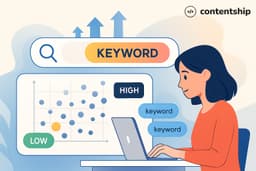
The fastest way to miss AI Overviews is to optimize one page for one phrase and call it done. AI Overviews tend to expand a query into several related sub-questions, then pull the best passage for each sub-question. If you do not show up across that expanded set, you are asking Google to pick you for the one query while it is judging you across five.
In practice, we treat fan-out as an engineering problem: define the input query, generate the 3-7 most likely sub-queries, then assign each sub-query a content target. Sometimes that is a dedicated cluster page. Sometimes it is a section in an existing page that can stand alone.
A useful threshold to aim for in one sprint is five fan-outs you can realistically own, not fifty you cannot maintain.
Step 2: Build Topical Depth With Clusters That Actually Ship
Topical authority is not a vibe. It is a coverage map that you can point to. The sites that get cited repeatedly usually have a cluster that makes the model’s job easy: it keeps bumping into the same domain while it fans out.
A pragmatic way to do this for an seo website is to pick one “money” topic and then build supporting pages that answer the questions your audience keeps asking during evaluation, onboarding, and troubleshooting.
Here’s where teams go wrong: they try to publish one mega-guide with everything. Mega-guides are fine, but AI Overviews often cite one passage, not your entire guide. Smaller pages with a tight promise can be easier to cite because the model can extract a clean answer with less risk.
If you want a sanity check for cluster scope, we like this rule of thumb. If a page’s H2s look like different blog posts, it probably should be different blog posts.
Step 3: Write Answer Capsules That Can Be Quoted Without Context
A citation-friendly page has multiple moments where a single paragraph answers a question fully. We call these answer capsules: a short, direct answer placed immediately under a question-style heading.
The goal is not “short content.” The goal is self-contained passages. If your answer relies on “as we said above” or only makes sense after three paragraphs of setup, you are forcing the model to either skip you or risk misquoting you.
A good capsule usually fits in 40-80 words, uses concrete nouns, and includes one clarifying constraint. For example, “This works when X, it fails when Y.” That constraint is exactly what makes an extracted answer feel trustworthy.
Step 4: Prioritize Long-Tail Informational Queries That Trigger AI Overviews
AI Overviews show up heavily on informational searches. The sweet spot is often the query that has enough context to require synthesis, but not so much that the answer is purely transactional.
For planning, we like to start with question-like long tails that mirror how a person actually asks for help, then validate which ones consistently show AI Overviews in live results. Treat this like QA: you are not done until you have observed the SERP.
This is also where “how to do seo on my website” becomes a useful pattern, not just a keyword. It implies the user is looking for an ordered method and expects steps, trade-offs, and checks.
Step 5: Increase Fact Density, Or You’ll Lose the Grounding Battle
AI Overviews are cautious about making claims without support. You see this in the citation behavior. Pages that include more verifiable facts are easier to ground and safer to cite.
The operational version of this is: every key section should have at least one of the following.
- A concrete number (benchmark, rate, percentage, time, cost)
- A cited definition from an official standard or documentation
- A clearly attributed study finding
If you do nothing else, aim for 10+ “key facts” across a page that you want cited frequently. Not fluff facts. Facts that change a decision, like the labor cost of producing content or the percentage of queries that show AI Overviews.
For credibility, anchor your facts in primary sources where possible. Google’s own documentation is the most defensible for how their systems behave. For example, Google outlines how it expects sites to approach AI-driven search experiences in its succeeding in AI search guidance. For structured data, rely on the canonical definitions at Schema.org.
Step 6: Structure Pages for AI Extraction (Headings, Lists, And Clean Sections)
Formatting is not cosmetic anymore. It is an extraction layer.
In the wild, citations tend to come from content that is easy to slice: descriptive headings, short paragraphs, and lists where lists make sense. You do not need to turn everything into bullets, but you should be intentional.
A practical pattern that keeps working is:
- Use an H2 that is a natural-language question.
- Put the answer capsule directly under it.
- Follow with a short expansion, then a list or mini-checklist if the topic is procedural.
Also avoid headings that tell neither humans nor machines what’s inside. “Quick thoughts” and “The bottom line” are fine in newsletters. On an seo website, they are a missed extraction opportunity.
Step 7: Add Schema Markup That Clarifies What The Page Is
Schema is not a magic “AI Overview schema.” But it helps Google understand your page and can improve how your content is interpreted and displayed.
Keep this grounded in the basics:
- If you publish FAQs, use FAQPage markup.
- If you publish step-by-step instructions, consider HowTo.
- If you publish editorial content, make sure your Article markup is complete and consistent.
Validate using Google’s Rich Results Test and, when you want schema-level validation independent of Google’s rich result eligibility, use the Schema Markup Validator.
The point is not to chase a badge. The point is to reduce ambiguity so the retriever and the model can classify your content correctly.
Step 8: Build Brand Mentions Where AI Systems Actually Look
One of the more uncomfortable truths about AI Overviews is that citations are not limited to “SEO-perfect” sites. AI systems pull from the broader web and tend to trust sources that are repeatedly referenced.
This is where brand mentions matter. An SEO strategist can’t treat off-site presence as “PR’s job” anymore, because it directly affects whether the model thinks your domain is a safe source.
A credible data point here comes from Ahrefs, which found that web mentions correlate strongly with AI Overview visibility. See Brand Visibility in AI Overviews: What Matters Most.
The operational version is not “go viral.” It is to show up consistently in places where your audience asks and answers real questions, and to do it in a way that doesn’t read like spam. If you are helpful, people repeat you. If people repeat you, models notice.
How to Track AI Overviews Without Getting Lost in Vanity Metrics
Tracking is where most teams either over-engineer or give up. The middle path is to track three layers consistently.
First, track whether an AI Overview appears for your target queries and whether you are cited. This is the new visibility layer.
Second, track whether the cited URL is one of your intended “capsule pages” and which passage is being extracted. If the wrong page is being cited, that’s usually a cluster and internal linking problem.
Third, track the fundamentals. If your page is not indexable, nothing else matters. Use Search Console’s URL Inspection tool workflows to confirm what Google sees.
When performance is part of the issue, ground decisions in Core Web Vitals and real measurements. Google’s PageSpeed Insights remains a practical starting point.
Website Design and SEO: Where Teams Accidentally Break AI Visibility
Website design and SEO collide in predictable places, and AI Overviews make the costs more visible.
The most common break is JavaScript-heavy rendering that hides the main content until client-side execution. That can be fine for users and still introduce delays or ambiguity for crawlers, which then reduces retrieval eligibility.
The second break is layout that forces content into tabs, accordions, or interactive elements without ensuring those sections are discoverable and indexable. If the answer capsule is visually hidden, it may as well not exist.
The third break is design systems that standardize headings in a way that makes them vague. Designers want consistent typography. SEO needs semantic clarity. You can have both, but you have to coordinate.
If you are working with seo website developers, the best collaboration move is to define “non-negotiables” that do not fight the design. Clear H2 hierarchy. Server-rendered or reliably indexable content. Fast mobile performance. And templates that support FAQ and HowTo sections where they actually help.
A Quick Checklist You Can Run in 1-3 Sprints
Use this when you need to turn the playbook into work that actually ships.
- Pick 1 core query and define 3-7 fan-out sub-queries.
- Build or adjust a cluster so at least 1 page targets each fan-out.
- Add answer capsules under question-style H2s in every key section.
- Add 10+ key facts with citations across your main page.
- Ensure headings are descriptive, paragraphs are short, and lists are used where procedural.
- Implement and validate schema for FAQs and steps.
- Plan 2-3 off-site mention opportunities tied to real questions.
- Track AIO presence, citations, and indexability weekly.
Conclusion: The SEO Website That Wins AI Overviews Looks “Quoteable”
If you remember one thing, make it this. AI Overviews don’t reward the page that repeats the keyword the most. They reward the seo website that is easiest to retrieve, safest to quote, and most consistently reinforced by topic coverage and brand signals.
The playbook is not complicated, but it is operationally heavy. Fan-out research, capsule writing, fact insertion, schema validation, internal linking, and tracking are the work around the article that most teams underestimate.
If you want help turning this into a repeatable engine, you can work with our team at Contentship to ship full Content Units that include the research, structure, quality gates, distribution formats, and refresh linking that make AI Overview wins compound over time.
Frequently Asked Questions
What Are the 4 Types of SEO?
For an seo website competing in AI Overviews, the four types map to execution layers: on-page (content and intent match), technical (crawl, rendering, speed), off-page (mentions and links that reinforce trust), and content architecture (clusters and internal linking that support fan-out retrieval).
Is SEO Free or Paid?
SEO can be “free” in media spend, but it is rarely free in labor. The paid part is usually tools, production, and coordination. For AI Overviews, the cost often shifts toward research, fact sourcing, and content formatting. You can pay with hours or with a managed process, but you pay.
How Do I Do SEO on My Own?
Start with one page that answers one clear question, then expand into a small cluster that covers the fan-out questions around it. Add answer capsules under question-style headings, support claims with cited facts, and validate indexability in Search Console. Track whether AI Overviews appear and whether you get cited, not just rank.
What Is SEO in a Website?
SEO in a website is the set of choices that make your pages discoverable, understandable, and trustworthy to search systems. In AI Overview terms, it means the page can be retrieved for the query and its fan-outs, the answer can be extracted as a self-contained passage, and the site has enough authority signals to be cited safely.