Last Updated: May 21, 2026
Search behavior has changed faster in the last year than most content teams expected. People still use Google, but they also ask ChatGPT, Gemini, Perplexity, and AI Overviews to summarize options, compare products, and recommend vendors. That shift is exactly why seo ai now matters beyond rankings alone. If your content only targets blue links, you can still miss the moment when an answer engine decides which brands to mention.
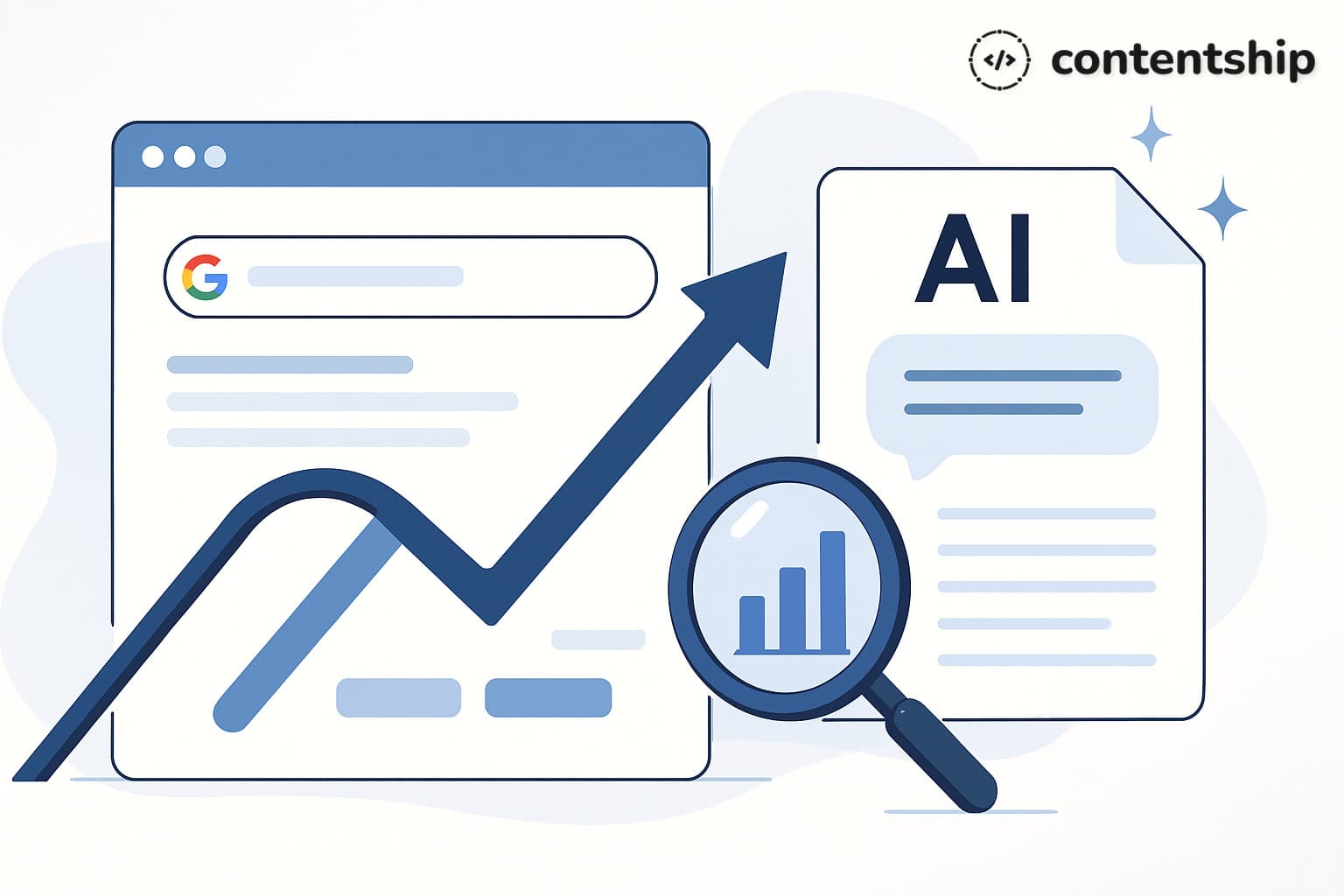
Answer engine optimization, or AEO, sits next to traditional SEO. SEO helps you earn visibility in search results. AEO helps you earn visibility inside AI-generated answers. The two overlap, but they are not identical. In practice, the teams seeing the best results are the ones publishing content that can rank, be parsed cleanly, and be trusted enough to get cited.
That sounds simple until you look at the work involved. The article itself is usually the visible part. The harder part is the research, structure, quality control, metadata, internal links, refresh cycle, and distribution that make content discoverable across both search and AI systems.
Want a quick AEO reality-check? See a sample Content Unit from Contentship.
What SEO AI Actually Means in 2026
When people search for seo with ai or using ai for seo, they often mean one of two things. Either they want AI to help them produce and optimize content faster, or they want to understand how search itself is changing because AI is now part of discovery.
The second meaning is the one that matters most. Search is no longer just a ranked list of pages. It is increasingly a layer of generated answers built from pages, brand mentions, citations, and structured evidence. That means your content has to do more than include keywords. It has to answer clearly, prove claims, and show up in places AI systems are likely to trust.
This is why we treat aeo seo as an operational discipline, not a writing trick. A page may be perfectly readable and still fail to get cited if it lacks original evidence, clear question-answer formatting, recency signals, or supporting mentions from relevant sites.
AEO vs SEO: Where the Difference Shows Up
The easiest way to think about the difference is this. SEO is about earning clicks from search results. AEO is about earning mentions inside generated responses.
With classic SEO, you optimize for rankings, click-through rate, and organic sessions. With AEO, you also watch whether your brand appears in AI responses, whether your pages are cited as sources, and whether branded search demand rises after those mentions. In other words, the output changes from Did we rank? to Did we become part of the answer?
That changes optimization priorities. Keywords still matter, but question formats, entity clarity, and claim support matter more than most teams realize. If your page says something useful but does not make the answer extractable, an LLM may skip it. If your brand has weak off-page signals, another source may be cited even when your article is better.
A practical example is high-intent comparison content. A standard SEO playbook might focus on ranking a category page. An AEO-aware playbook asks a second question. If someone asks an AI assistant for the best options in that category, does your brand have enough authority and enough answer-ready content to be mentioned at all?
How Answer Engines Choose What to Mention
Most teams assume answer engines work like a thinner version of Google. They do not. They synthesize. That means they look for content that is easy to interpret, specific enough to quote, and credible enough to include.
Three patterns show up repeatedly.
First, question-aligned content performs better than vague topic coverage. If a section heading mirrors a real user question and the answer appears immediately below it, machines have a much easier time extracting the point.
Second, evidence beats generic advice. Original data, concrete examples, linked sources, and direct experience create the kind of confidence answer engines need before citing a page. Research on generative engine visibility found strong correlation between source visibility and signals such as citations, quotations, and statistics, with improvements of over 40% across queries in the tested scenarios, according to the paper Geo: Generative Engine Optimization.
Third, recency matters more than many content teams planned for. If your best page was last updated 18 months ago, it may still rank, but it can lose relevance in AI-generated responses that prefer fresher supporting material. That pattern also aligns with findings from the AirOps content refresh study, which reported that more recent and clearly updated pages were cited more often in ChatGPT answers.
How to Do SEO with AI Without Falling Into the Automation Trap
This is where a lot of teams go wrong. They assemble a stack, connect a few prompts, generate articles at scale, and assume velocity will produce visibility. Usually it produces a content backlog with weak differentiation.
The better way to use AI for SEO is to assign it the repeatable work while keeping strategy and editorial judgment human-led.
Start with search and answer demand. You need to know what people ask in Google, what they ask inside LLMs, and where your brand is absent from both. Then build pages around those questions with direct answers near the top, supporting details underneath, and proof wherever claims could be challenged.
After that, use AI for the operational layer: semantic coverage checks, internal link suggestions, title and meta variations, content scoring, refresh prompts, and distribution formatting. This is where a strong seo ai tool helps. The goal is not to replace judgment. The goal is to reduce the coordination overhead around every publish cycle.
That difference is bigger than it sounds. Our research on content production costs found that a single SEO article often requires 11.5 hours of internal labor before anyone writes a word. Strategy, SERP review, briefing, revisions, QA, formatting, metadata, and promotion are what scale poorly. The article itself is only part of what makes content work.
This is also why the question is rarely just what is the best ai seo tool. The more useful question is which system handles the work around the article. We built Contentship around that reality by treating a publishable content asset as a full operational unit, not just a draft.
A Practical AEO Workflow That Actually Scales
If you are an SEO strategist trying to show measurable wins, keep the workflow simple and inspectable.
1. Start With Questions, Not Broad Topics
Choose real questions with business intent. Good AEO targets often look like product comparisons, implementation questions, cost questions, migration concerns, and vendor selection prompts. These are the prompts users ask both search engines and answer engines when they are close to action.
Do not stop at keyword volume. A low-volume question with strong buying context can outperform a broader topic if it earns AI citations and branded follow-up searches.
2. Answer Early and Expand After
Use the heading as the question. Then answer it in the first two or three sentences of the section. After that, add examples, trade-offs, steps, or source-backed context.
This structure works because it serves both systems. Humans get the answer quickly. Machines can parse the answer cleanly.
3. Add Proof Wherever the Claim Is Specific
If you say AI traffic converts better, cite the source. If you say refreshed content gets cited more often, cite the source. If you say structured content increases answer eligibility, show the pattern and explain why.
For visibility tracking and baseline metrics, the official Google Search Console performance report documentation is still essential. Google also explains how impressions, clicks, and position are counted, which matters now that AI-driven search experiences affect visibility without always producing a click.
4. Refresh for Recency, Not Just Accuracy
Many teams only update content when it becomes wrong. That is too late for AEO. Update when examples age, screenshots feel old, competitor context shifts, or new platform behavior changes how answers are formed.
The practical signal here is simple. If a buyer asking the same question today would need a meaningfully different answer than six months ago, refresh the page.
5. Measure Mentions, Not Just Sessions
Track rankings and clicks, but add a second dashboard for AI visibility. Check whether your brand is cited in major AI tools for your target prompts. Monitor branded search lift, impressions, and movement in non-brand queries after publishing answer-focused content.
A lightweight setup works fine at first. Build a prompt set, test it every month, and record whether your brand is mentioned, linked, or omitted. For many teams, that gives faster signal than waiting for organic traffic alone.
What to Measure When SEO AI Is Working
The most important shift in measurement is accepting that visibility can create value before the click happens.
If your brand starts appearing in AI-generated answers, you may first notice it as higher branded search volume, stronger impression growth, better assisted conversions, or more direct traffic from people who heard your name in an answer and came back later.
That pattern is one reason we advise teams to combine classic SEO metrics with answer-engine indicators. Track rankings, impressions, and clicks. Then layer in AI citations, prompt-level presence, branded query growth, and page refresh impact.
A good compact scorecard includes these metrics: target query rankings, search impressions, branded query impressions, AI citation rate for priority prompts, and assisted conversions from organic landing pages. If one page improves in all five, it is doing more than ranking. It is shaping discovery.
We have seen this matter in practice. On our customer results page, one developer-tools company grew organic clicks from 423 to 1,250 in three months, while impressions rose from 66,600 to 293,000 and average position improved from 10.9 to 8.8. The takeaway is not that every page will move that fast. It is that execution across research, structure, quality control, and distribution compounds faster than draft generation alone.
Which AI to Use for SEO?
There is no universal winner because different tools solve different layers of the workflow. Some products are good at drafting. Some are good at optimization scoring. Some function like a seo ai keyword rank checker by helping monitor positions, visibility, or topic gaps. Others focus on prompt discovery or entity research.
For an SEO strategist, the right stack usually includes four capabilities: question discovery, SERP and competitor analysis, content production support, and visibility measurement. If a tool only writes, it is incomplete. If it only scores, you still need the production system around it.
That is why buying a platform because it is marketed as the best ai seo tool often leads to disappointment. The label says less than the workflow. You need to know whether the tool helps you produce evidence-backed, answer-ready content and maintain it over time.
If you are comparing point solutions, keep the evaluation simple. Can it help you identify question-based opportunities? Can it enforce structure and quality? Can it support refresh cycles? Can it show whether your content is actually gaining visibility? If not, it may still be useful, but it is not enough on its own.
You will also see branded searches for specific products, including terms like otto seo ai. Those tools may fit a narrow need, but the principle is the same. Evaluate the operating model, not just the interface.
Where a Managed Content System Fits
Once teams understand AEO, the bottleneck usually moves from knowledge to execution. They know they need question-led pages, stronger proofs, tighter structure, and regular refreshes. What slows them down is the work around every article.
That is the gap we designed Contentship to solve. Instead of treating content as a document, we treat it as a governed workflow that includes SERP analysis, outlines, quality validation, metadata, internal linking, formatting, distribution assets, and refresh linking. In other words, we focus on the 80% around the article that most teams still have to coordinate manually.
This is especially relevant for lean marketing teams and founders handling content without a full editorial operation. Building a DIY AI pipeline looks efficient at first, but maintenance is usually the hidden cost. Workflows break, models change, prompts drift, and quality becomes inconsistent. That is why our position has always been that AI should extend human judgment, not replace it.
Conclusion: SEO AI Works Best When Content Is Built to Be Quoted
The simplest way to understand seo ai is this. Traditional SEO gets you into the results. AEO helps get you into the answer. If you want both, your content needs to be easy to extract, strong enough to trust, and current enough to cite.
That means focusing on question-based structure, clear answers near the top, supporting evidence, off-page mentions, and a refresh process that keeps key pages relevant. It also means measuring more than traffic, because citations, branded search lift, and impression growth often show up before the click does.
If you want to operationalize that without adding another 11.5 hours of coordination around every article, a practical next step is to explore Contentship and see how we help teams build content that can rank in Google, get referenced by LLMs, and stay top-of-mind.
Frequently Asked Questions
Is SEO Still Worth It With AI?
Yes. AI has changed how discovery happens, but it has not replaced search demand. SEO still earns visibility in search results, while AEO helps you appear in AI-generated answers. The stronger strategy is to treat both together, because users now move between Google, AI assistants, and direct brand searches during the same journey.
How to Do SEO with ChatGPT?
Use ChatGPT to speed up research synthesis, outline generation, content gap analysis, and refresh ideas, but do not let it define strategy on its own. The best use of ChatGPT in seo ai workflows is operational support. You still need SERP validation, source-backed claims, human review, and a structure built for both ranking and citation.
Which AI to Use for SEO?
Use the AI that fits the job. Some tools help with drafting, others with optimization, prompt discovery, or rank monitoring. For most teams, the best setup is the one that covers question research, content quality, refresh workflows, and visibility measurement rather than just article generation.
Can You Do SEO with AI?
Yes, but only if you use AI as part of a process, not as a shortcut. AI can accelerate keyword clustering, content briefs, semantic checks, and updates. It usually fails when teams expect raw generation to replace strategy, editorial standards, technical validation, and distribution.