Last Updated: June 05, 2026
Content teams are shipping more pages than ever, but a lot of those pages quietly fail for a simple reason. They are “fine” for humans and still incomplete for modern discovery systems. Google wants the best answer for a query. AI assistants want clean, attributable passages they can quote. And your buyer wants proof you understand their problem without making them work for it.
If you are an SEO strategist in a small to mid-size org, this is the weekly reality. You need a process that turns drafts into assets that rank, earn clicks, and stay referenceable. This is where an ai seo content generator helps, but only if you treat it like an optimization workflow, not a text vending machine.
1) Start by Matching Search Intent, or everything downstream is wasted
The fastest way to improve rankings is to stop publishing the “wrong shape” of content. Intent alignment is the multiplier. When a query’s top results are comparison lists and you publish a glossary definition, you can polish on-page SEO all day and still stay stuck.
A practical way to spot intent mismatch is to look at the current SERP and ask: what did Google decide the user wants right now. If you see listicles, pricing pages, and “best X” roundups, the intent is mixed commercial and informational. Your page needs to acknowledge that quickly, usually by leading with a short recommendation framework, then backing it with details.
Once you have that, write each section using BLUF. Put the answer in the first sentence, then explain why it is true and what to do next. AI tools also prefer this structure because it produces quotable chunks.
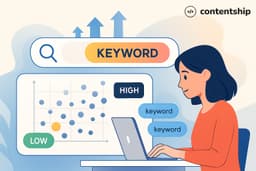
See prioritized keyword opportunities with Contentship. Run our AI-driven content scoring to find low-effort, high-impact wins you can act on this week.
2) Build Topic Coverage with Secondary Keywords, not keyword stuffing
A page rarely wins because it repeats one phrase. It wins because it covers the topic like someone who has done the work, using the language real searchers use.
Start by assigning one primary target, then add a small set of secondary keywords that reflect adjacent needs. For this topic, that might naturally include seo writing assistant, seo content writer, and seo writer because people searching for “AI SEO content” often also evaluate who or what will produce it. Use these terms when they fit, but avoid forcing them into headings if it makes the section less clear.
The real tactic is to map secondary terms to sections. If a section explains how to answer questions for AI tools, it might naturally reference the workflow a content strategist uses. If a section focuses on refreshing content, it may mention what a content marketing manager tracks week to week. That is not “SEO magic”. It is simply making your page match the mental model of the searcher.
One trade-off to be aware of is breadth vs focus. If you add too many subtopics, the page becomes a “miscellaneous” post and loses topical sharpness. A good rule is to include secondary concepts only when they help the reader complete the job that brought them to the page.
3) Optimize for AI prompts by Writing Full Answers to Real Questions
Search queries are short. AI prompts are often full sentences. That difference changes what “optimized” looks like.
The pattern we see across B2B sites is that teams answer questions implicitly, buried inside long paragraphs. AI systems are more likely to cite pages that answer explicitly, close to the question, in plain language.
Pull question phrasing from places you already have. Sales calls. Support tickets. Chat logs. Community threads. When you add these questions to your page, keep them as full questions in H2s or H3s when it is natural, then answer in 2 to 4 sentences before you expand.
This is also where you can create “citation-friendly” blocks without gaming anything. A short definition, a clear process, or a compact set of criteria is easier for AI tools to lift and attribute.
4) Make on-page SEO Boringly Perfect (titles, descriptions, internal structure)
On-page SEO is still where most quick wins live, because it is usually neglected. You do not need hacks. You need consistent execution.
Your title should describe the page, not just tease it. Google is explicit about how it chooses and rewrites titles. Start with a descriptive phrase that matches the page’s main topic, and avoid stuffing variants. The best reference for this is Google’s guidance on influencing title links in Search.
Then make sure your page is easy to parse. Use one H1. Use H2s for major sections. Use H3s for questions or sub-steps. Keep paragraphs short. If you need a list, use it to clarify steps, not to pad the post.
Here is a quick on-page checklist we use when a page is close to ranking but cannot break into the top results.
- Make the title and intro match the dominant intent. If the SERP is “best tools,” your first screen should acknowledge evaluation criteria.
- Add a 40 to 60 word summary near the top when featured snippets are common for the query.
- Ensure images have descriptive alt text that actually describes the image, not just a keyword.
- Add 3 to 5 internal links that help the reader complete the next step, and make sure the anchor text says what they will get.
5) Win SERP Features by Structuring Answers, not rewriting everything
A lot of teams chase SERP features after the fact. The better approach is to design for them when you outline.
Featured snippets and People Also Ask boxes tend to reward pages that answer a question quickly, then go deeper. That is why BLUF works. It gives Google a clean extraction candidate, and it gives the reader confidence they are in the right place.
AI Overviews and similar AI layers also tend to cite content that is both clear and well-scoped. If your section tries to answer five questions at once, it becomes hard to cite. If each section answers one question well, your page becomes a library of quotable parts.
The trade-off is that this structure can feel repetitive if you overdo it. Keep the BLUF tight. Then vary the supporting detail with examples, edge cases, and constraints.
6) Use Semantic Language to Show Depth (and help AI systems understand context)
Semantic keywords are not a checklist. They are a signal that you actually covered the topic.
If you are writing about content optimization, the page should naturally use related concepts like search intent, SERP features, internal linking, readability, and E-E-A-T. When those terms appear because they belong, your content becomes easier for both ranking systems and AI systems to classify.
A practical tactic is to scan your draft and look for vague nouns. “This” and “that” and “it” are clarity killers. Replace them with the actual concept, but do it once. You are not trying to repeat the phrase. You are trying to remove ambiguity.
This is where many teams rely on a seo writing assistant to suggest missing concepts. That can help. The important part is that the suggestions map to real user needs and SERP expectations, not just “more words.”
7) Keep Content Fresh, because recency now impacts AI visibility too
Freshness is not just an SEO concern anymore. It is also an AI citation concern.
A strong signal here comes from Seer Interactive’s research on AI brand visibility and content recency. They found that AI bot activity heavily concentrates on recently published or updated pages. In practice, this means a page that ranked well in 2022 can become invisible in 2026 if it is not maintained.
The weekly playbook is simple. Identify pages that have business value, then refresh them on a schedule. Update examples. Fix broken links. Add new internal links to newer posts. Expand sections that are thin compared to what the SERP now expects.
If you want this to be measurable, track changes in rankings and click-through rate after each refresh. If a refresh did not move performance, the issue is often intent mismatch or incomplete coverage, not “not enough updates.”
This is also a place where we built automation into our workflow at Contentship. We monitor feeds across your space, deduplicate repeated stories, and score opportunities against your strategic context so you can spot when a topic is shifting and which existing URL should be refreshed first.
8) Treat E-E-A-T as Page Design, not a box to tick
Google’s systems are engineered to reward content that feels credible, accurate, and experience-based, especially in competitive categories. The most useful thing you can do is make credibility obvious.
Start by aligning with Google’s people-first guidance on creating helpful, reliable content. Then look at how quality is evaluated through the lens of the Search Quality Rater Guidelines. You are not optimizing for raters directly, but the guidelines are a clear window into what “high quality” means in practice.
In real-world content, E-E-A-T shows up as specifics. You mention constraints. You explain trade-offs. You cite primary sources. You avoid sweeping claims you cannot support. When you use stats, link to the original report.
There is also emerging research on how generative systems select sources. The paper Generative Engine Optimization suggests that content with clear structure and credible references is more likely to surface in AI outputs. You do not need to “optimize for the paper.” But it reinforces the same operational truth. Clarity plus credibility travels further.
9) Optimize Images and Visuals for Speed and Comprehension
Visuals help comprehension. They also quietly hurt performance when they are heavy, unlabeled, or irrelevant.
From an SEO standpoint, image optimization is mostly about page experience and accessibility. From a practical standpoint, it is about not sabotaging Core Web Vitals with oversized assets.
If you are unsure where to start, web.dev’s guidance on image performance is a solid baseline. The key patterns are consistent. Use modern formats where possible. Compress aggressively. Do not lazy-load the biggest above-the-fold image if it delays rendering. And always write alt text that describes what the image shows.
A useful test is to ask: if the image did not load, would the reader lose meaning. If the answer is no, the image is decoration. That is fine sometimes, but it should not be your heaviest asset.
10) Cover the Topic Comprehensively, but earn the right to go long
Comprehensiveness is not length. It is completeness.
Most underperforming content is missing the “middle” of the topic. It defines the concept, then jumps straight to tools, and skips the actual decisions people struggle with. Those decisions are where you should spend words.
When you update or rewrite a page, compare your outline to the current SERP. If every top result covers the same subtopics and you skip two of them, you have likely found why you are not ranking. If every top result says the same thing, your advantage comes from being more specific, more current, or more experience-driven.
This is where a freelance seo writer can still be a great investment, as long as you brief them with real constraints, real examples, and clear intent. The problem is not writing capacity. The problem is vague inputs.
11) Add Original Research When you need Backlinks and AI Citations
Original research is the easiest way to give other sites a reason to reference you. It also gives AI tools something unique to cite.
This does not have to be a massive survey. It can be aggregated internal benchmarks, anonymized patterns from your own analytics, or a structured teardown of what changed in your category over the last six months. The point is to create a piece of information that did not exist before your page existed.
The trade-off is effort. Research takes time. When you do it, make sure you can reuse it. Turn it into a chart. Summarize it in a short section that can be quoted. Then link to your methodology so it is credible.
12) Optimize for Conversions Without Breaking Trust
Conversion optimization in content is mostly about timing and relevance. If the page is informational, the conversion is usually the next step. A worksheet. A comparison framework. A demo request. But it must match what the reader is ready for.
The simplest approach is to place one helpful next step after you have delivered real value. Not at the top. Not mid-sentence. After the reader has enough context to act.
Social proof can help, but only when it is specific. Avoid vague testimonials. A short outcome tied to a constraint is far more believable than a generic compliment.
13) Put your Workflow on Rails so Optimization Happens Every Week
Most teams know what to do. They just cannot do it consistently because content operations are messy.
A workable workflow looks like this. Monitor what is changing in your market. Triage what matters. Map it to personas and keywords. Draft in a structured way that supports SEO and AI visibility. Publish. Then measure and refresh.
This is where a content strategist often becomes the system designer, and a content marketing manager becomes the operator. When the workflow is clear, writers spend time on substance instead of rework.
In our experience, the gap is usually in triage. Too many ideas. Not enough prioritization. That is why we built AI-driven scoring, competitor mention detection, and keyword opportunity scoring into Contentship, so you can focus your writing time where the impact is most predictable.
14) The 15-tactic Implementation Plan You Can Run This Week
If you want a tight plan, run this as a short sprint.
First, pick one URL that already has impressions but underperforms on clicks. That means Google is testing you, and optimization can pay off faster.
Second, confirm intent by reviewing the current SERP and rewriting your first screen to match. Then add a short summary that answers the main question cleanly.
Third, add 3 to 5 secondary keywords only where they clarify meaning. Tighten headings so each section answers one question. Then add 3 to 5 credible outbound links to primary sources and 3 to 5 internal links to your next-step pages.
Fourth, refresh anything stale. Update dates where appropriate, but only when the substance truly changed. Fix broken links. Replace outdated screenshots.
Finally, measure. Track rankings for the primary term, CTR, organic traffic to the page, and whether your content is being cited in AI tools. The KPI is not “we updated it.” The KPI is “it now earns demand.”
Conclusion: Make the AI SEO content generator the last step, not the first
The teams winning right now are not the ones publishing the most. They are the ones shipping content that matches intent, answers real questions cleanly, stays fresh, and reads like someone with experience wrote it.
An ai seo content generator can accelerate drafts, but the durable advantage comes from your optimization system. When you get the workflow right, every refresh compounds, and your best pages keep earning visibility in both search and AI results.
Ready to stop guessing and start ranking for both search and AI. Let Contentship become your AI-powered content team. Request a demo to see prioritized keyword discovery, content scoring, and competitor alerts in action.
FAQs
What is content optimization in 2026, beyond classic SEO?
It is updating and improving pages so they rank in search and remain easy for AI systems to understand and cite. In practice, it means intent alignment, clear answers, credible sourcing, and ongoing refreshes.
How do I optimize content for AI citations without writing for robots?
Write for humans, but structure for extraction. Use full-question headings where appropriate, answer directly in 2 to 4 sentences, then expand with examples and constraints.
How often should I refresh content to protect rankings?
Refresh when the SERP changes, your rankings drop, or your examples and sources are outdated. A quarterly review of your top business pages is a good baseline, then adjust based on volatility in your niche.
Do I need an SEO content writer if I use AI tools?
Often yes, because the hard part is not generating text. The hard part is making the page accurate, complete, and intent-matched, and that requires editorial judgment and subject understanding.
Where does Contentship fit in an optimization workflow?
It fits at the triage layer. We help you monitor what is changing, deduplicate noise, and score ideas and refresh opportunities against your personas and keywords so you can prioritize the right work.
Sources and further reading
- AI brand visibility and content recency (Seer Interactive)
- Creating helpful, reliable, people-first content (Google Search Central)
- Influencing title links in Google Search (Google Search Central)
- Search Quality Rater Guidelines (Google PDF)
- Image performance (web.dev)
- Generative Engine Optimization paper (arXiv PDF)